The Runner
In a nutshell
Markus Torgeby drew a line under his life and went into the Swedish wilderness, where he lived alone for years and ran. Instead of escaping into alcohol or drugs, he chose a much harder path to inner peace.
Who it's for: Anyone who has ever wanted to simply disappear.
Drawing a line under your life and simply disappearing. Probably everyone has felt that urge at some point. But very few people at that moment managed to follow their inner voice and set off on the right path. Many take the road to alcohol and drugs, which bring only temporary comfort. There’s usually no way back from that road. Rich Roll knows all about it; he described his fight with addiction in Finding Ultra. So does Charlie Engle, who battled drug addiction. Markus, however, chose a much harder path: the path towards his inner self.
It’s a sunny autumn afternoon in 1999. Markus (23) is running along a trail by the Indalsälven river towards Lake Helgesjön. There he throws off his clothes and jumps into the icy water. He scrubs the mud and sweat off his body with sand. On the shore he gathers his things and walks naked into the forest to his tent. He chops wood, lights a fire and prepares dinner: crispbread with butter and warm water. The fire slowly burns down and Markus lies down in his sleeping bag. He writes a few notes about the day and then just watches the stars in the Swedish sky.

After this opening, the reader is taken back in time. We return to 1985 and the small Swedish island of Öckerö, where Markus lives. It’s Christmas Eve. Markus is nine years old and the eldest of four children. His mother’s condition has got worse again. Even at Christmas she ended up in hospital. He feels her starting to disappear before his eyes.
The following year, with no running background, he takes part in the traditional 10 km run around the island. He finishes in about 44 minutes. Running got him hooked. He started training and gradually improved his time by six minutes. Before long he was competing at national level. Running became his escape from the problems at home. He trained up to 14 times a week. But to get to a running track he had to travel to the Swedish mainland, a good two hours each way. The physical and mental grind gradually meant he couldn’t “sell” his training speed in races. He fell short of his own expectations and those of his coaches.
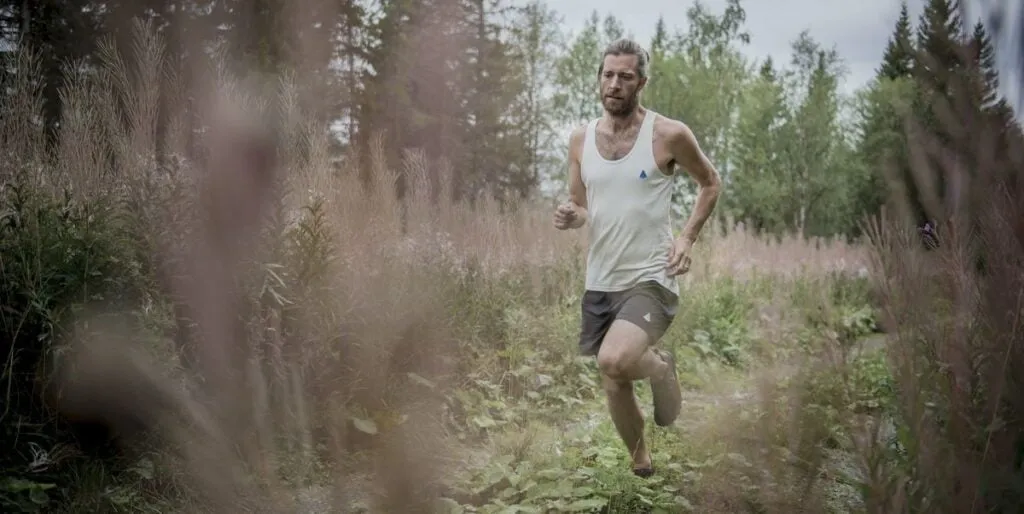
Markus Torgeby
One day he grabs his 40 kg backpack and literally runs away into the wilderness. It becomes his home for four long years. But he knows he can’t run away from himself. He needs to sort out his thoughts and calm himself down. In the forest he builds his tepee, which gives him a base and a sense of security. In summer, but above all in the harsh Swedish winter. He gradually starts to notice the nature around him, the sounds and workings of the forest. He becomes part of his new environment. He goes back to his roots to find his way.
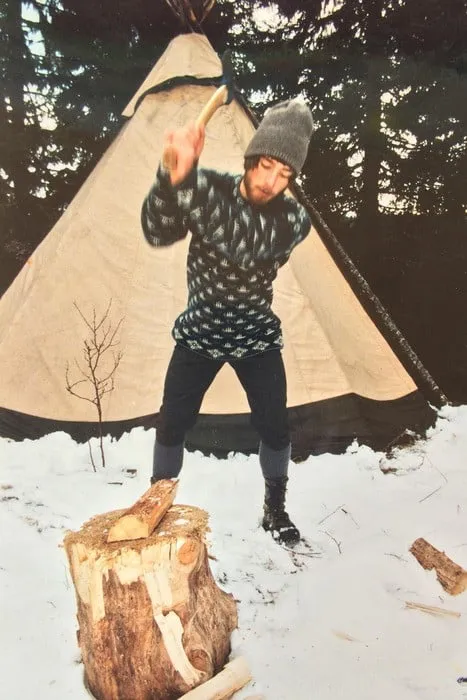
Life in the forest
The Runner and a trip to Africa
So Markus spends these years truly alone with himself. From time to time he escapes from the wilderness back to town, sometimes to shop, sometimes to earn a bit of money, and he even tries a race. An interesting detour is a trip to Tanzania, where he trains with local runners. Like Adharanand Finn in Running with the Kenyans, Markus also wonders why these African runners perform so well. In the end he returns to his tepee.
As Markus writes in the introduction, this book doesn’t offer a guide to becoming a faster runner. Instead, it shows a possible way to reach your own heart through running. I was curious how the book would end. Would he be one of those oddballs who went off into the wilderness to go mad, or would he manage to return to civilisation?
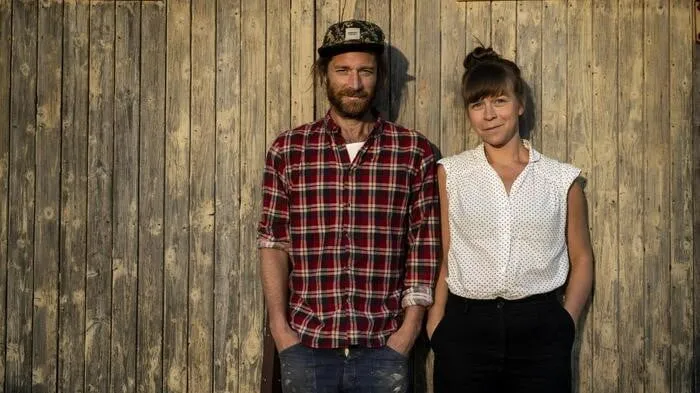
Together with Frida
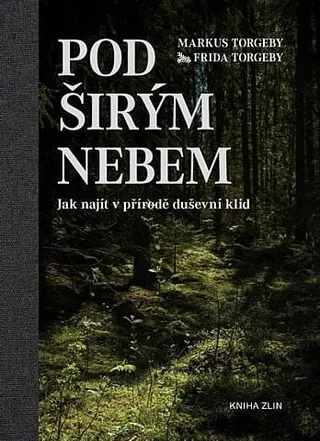
The author wrote the book several years later. One of the last chapters is called “Ten years later”. Markus has built a cabin and started a family. But will he manage to combine running twice a day, as he has done day after day for the last 20 years, with family life? You’ll find the answer, and maybe a guide too, in his new book “Under the Open Sky”, which came out in Czech in 2020 thanks to the publisher Kniha Zlín. I’m really looking forward to it.