Running for my life
In a nutshell
Lopez Lomong was running for his life at the age of six as a refugee from Sudan. He later made it to the USA, represented it over 1500 metres and started helping where he was born. A story no one could make up.
Who it's for: Anyone looking for a powerful life story.
They say life is the best scriptwriter. Nobody could have made up Lopez Lomong’s story. And if they had, nobody would believe it. We’re used to reading about runners who manage to run a marathon at the South Pole, cross the Sahara or run around Iceland. Stories where authors surpass themselves after years of training and push the boundaries of the impossible. Lopez didn’t have much chance to train. Yet he lined up for the most important run of his life at the age of six. He was running for his life. Running for My Life begins.
The beginning of the book takes us to the remote village of Kimotong in southern Sudan. A civil war is raging in the country, but somewhere far beyond the horizon. Six-year-old Loppepe is enjoying the life of an ordinary African child. It’s Sunday, so he sets off with his parents to church. He has no idea that his childhood ends today.
Rebel soldiers raid the village. They load all the children onto the back of a truck and take them away to an unknown place. The story moves to a small hut in a prison camp. The children spend several long weeks there in inhuman conditions (even by African standards). The weaker ones die day after day, the stronger ones start training with the rebels. Loppepe is somewhere in between. They are waiting to see whether he will die or grow big enough to start firing a machine gun too. He gets food once a day: grain porridge with sand. Even a small child knows he can’t survive this. He isn’t alone. Among the children are three older boys from his home village (more than once he calls them his angels in the book). They take him under their wing. They plan an escape, which they manage under dramatic circumstances. Barefoot and without water, they ran for several days and nights across the African savannah, heading home. Loppepe was running for his life (in the Buya language, Loppepe means “fast”).
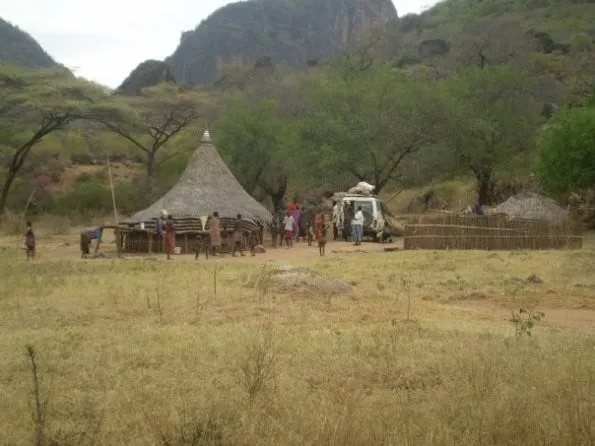
Kimotong
Running for my life
But they chose the wrong direction. After a few days, soldiers caught them. Fortunately not the rebels, but soldiers from Kenya. The disoriented boys had run all the way to the border. Once again they were loaded onto trucks and taken somewhere unknown. This time, though, the soldiers looked more civilised, the trucks more modern and the roads were tarmac. That at least gave them hope.
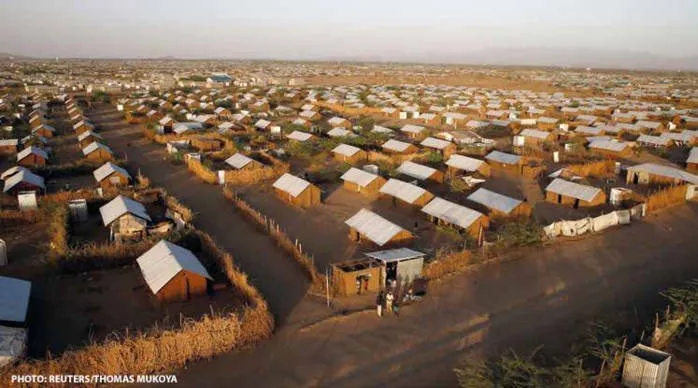
Kakuma
The destination was the town of Kakuma, a refugee camp near the border with Sudan. A place where fifty thousand people live, or rather survive. People with no hope of a better future. This place becomes little Loppepe’s home for ten years. Feel sorry for himself or accept his fate? The author offers an interesting view and strength of character through a child’s eyes. How do you survive this somewhat friendlier hell on earth? Food once a day, once a week a chance to rummage through the rubbish bins, and at Christmas one chicken for ten people. The only way to survive is to keep busy somehow. School, church and above all football become the entertainment. But there are so many children who want to play. So the older boys come up with a rule: whoever wants to play must first run around the camp. The full loop is 30 km. Loppepe wants to play football every day. He started running. After completing the loop, the reward finally came: he could run out onto the football pitch too.
One afternoon, the older Lopez gets outside the camp. At a local farmer’s, on a small black-and-white TV powered by a car battery, he watches the Olympic Games in Atlanta. Until then, football was the only sport he knew. He was surprised that anyone considered running a sport. Fascinated, he watches Michael Johnson’s final race. He takes the gold medal. And Lopez has his dream. He too wants to run one day with USA on his chest.
A few more years pass before hope appears. Write a motivation letter and hope they choose you for America, which as part of humanitarian aid is offering help to 3,500 of these lost children. Lopez is lucky and gets chosen. His stopover is Nairobi, where he waits for his flight to the USA.
Months go by and he starts to lose hope. There must have been a mistake somewhere. There wasn’t. In June 2001, Lopez flies off to America. He has no idea about distances, so he’s ready to get off the plane as early as Cairo. No, that’s not America yet. Nor is his next stop in Beijing. Third time lucky, New York welcomes him. All that’s left is a short flight to his final destination, the town of Syracuse. A new, adoptive family is waiting for him there.
If moving from Kakuma to Nairobi took him a century forward, moving from Kenya to the USA took him a whole millennium. How is it possible that one country has an absolute lack of everything while another has such enormous surpluses? There could hardly have been a greater contrast than a stop at McDonald’s on the way from the airport to his new home…
But there was more that was new. How do you switch off a light? How do you turn on the water? How can a toilet be inside the house and not out in the yard? He spoke very little English. His universal answer to all his new parents’ questions became the word “yes”. A really interesting part of the book about what such a drastic change of environment does to a person.
No wonder Lopez needed something to hold on to so he wouldn’t go mad from it all. Running offered him help. He told his new parents he’d like to go for a run. He didn’t quite understand why they gave him shoes and why he couldn’t run barefoot as he was used to. But he didn’t want to offend them. Asked how far he would run, he answered as usual: thirty kilometres. His parents didn’t know how much a kilometre was, because in America distance is measured in miles. So they called the coach of the running club. He couldn’t believe what he heard. Did you really say thirty and not thirteen? When Lopez came back from his loop, the coach was already waiting and ran the last mile with him. But Lopez ran away from him, because he understood that the coach was running too slowly. A translation error. He had just been recruited into the local high school’s running team.
First race, first win. But nobody had explained to Lopez that the golf cart driving in front shows the race route. He thought the winner was whoever caught up with the cart and overtook it. He managed it seven times. He finished with a massive lead over everyone else.
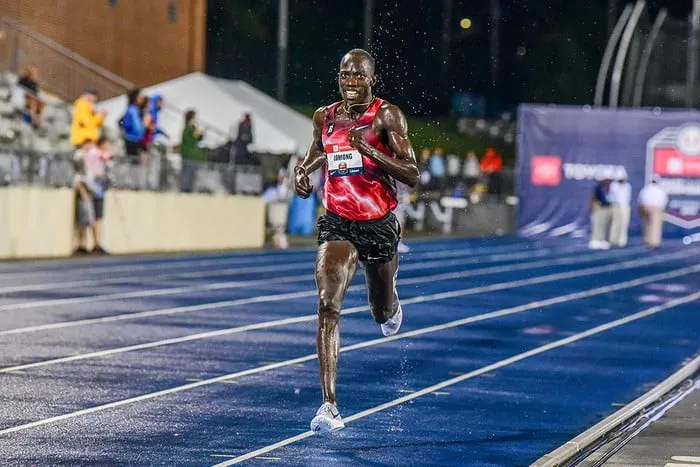
Lopez Lomong
It was 2001 and Lopez was thrilled with America. He didn’t speak much English yet, but the TV made it clear what had happened in New York on 9/11. That can’t be possible. I’ve just escaped a war, and it has caught up with me in America? In the America of my dreams? This topic is also handled in an interesting way.
The American dream continued. High school and then university. Lopez had a clear goal: to make it to the Olympic Games. He worked on himself and improved year after year. He even won the key race that earned him a place on the US team for the Pan American Games. The long-awaited selection came: to represent the USA. Just like Michael Johnson. Just as he had seen it “long ago” in Kakuma. But he turned the offer down. He had something more important to do. He had to go back to Africa. Someone in Kakuma was looking for him…
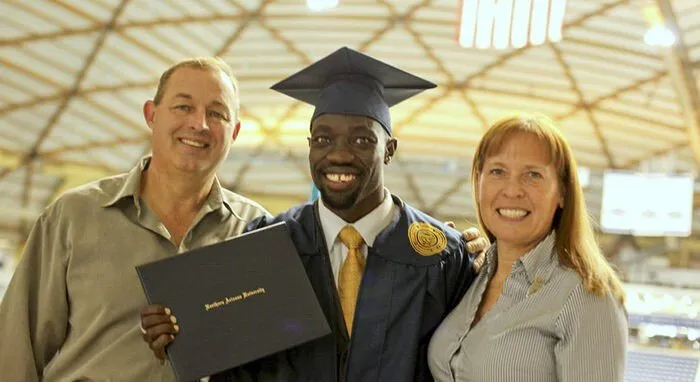
Lopez with his American parents
Before long he was back in the USA and kept racing. He was also energised by his hero Michael, whom he was introduced to at one of the races (Johnson also wrote a blurb for this book). Then came his big race, where he fought for Olympic selection for Beijing. It was close, but he made it.
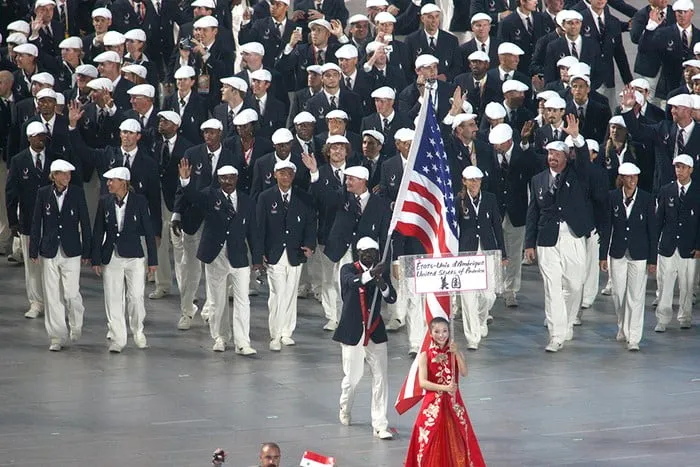
Opening ceremony of the Olympic Games
So years later he returned to Beijing. No longer as a refugee, but as a member of the US team. Together with 587 other athletes (among them Deena Kastor, who wrote Let Your Mind Run). But he wasn’t there just to make up the numbers. He was the most important of them all. Team USA chose him as the flag bearer (the book also describes how he was chosen). He then got his final “instructions” from President Bush at a private meeting.
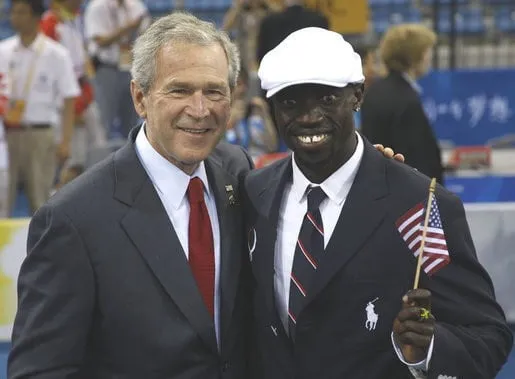
US President George W. Bush and Lopez Lomong
Lopez ran the 1500 m. How he did is already part of sporting history. He didn’t disappoint. He fulfilled his dream. But what matters more to him is that he didn’t use this opportunity, given to him by God, only for himself. He joined forces with the World Vision foundation and started helping where he was born.