Triumph
In a nutshell
Journalist Jeremy Schaap returns to the 1936 Berlin Olympics, where Jesse Owens triumphed on the track and morally. The book reveals the racism, propaganda and backstage of the Games and indirectly raises questions that are still relevant today.
Who it's for: Anyone who believes sport can be more than performance, runners interested in athletics history and Olympic fans.
Running isn’t just about kilometres in your legs. It’s also a story. And this book, Triumph: The Untold Story of Jesse Owens and Hitler’s Olympics, is exactly the kind of story that everyone should read who has ever started running not just for fun, but out of a belief that sport has the power to change the world.
📘 What is the book about? In this richly told book, American journalist Jeremy Schaap goes back to Berlin in 1936. To a time when the world was teetering on the edge of catastrophe, Hitler was trying to use the Olympic Games as a propaganda tool and running became a symbol of resistance. The main hero is, of course, Jesse Owens: four-time gold medallist, an African American who, in the heart of Nazi Germany, triumphed not only on the track but morally too.
But Schaap doesn’t just write about sporting results. He reveals the context of the time: racism in the USA and Europe, political pressure, preparations for the Games and the behind-the-scenes battles which, seen from today, are frightening in how similar they are to the modern manipulation of big sporting events.
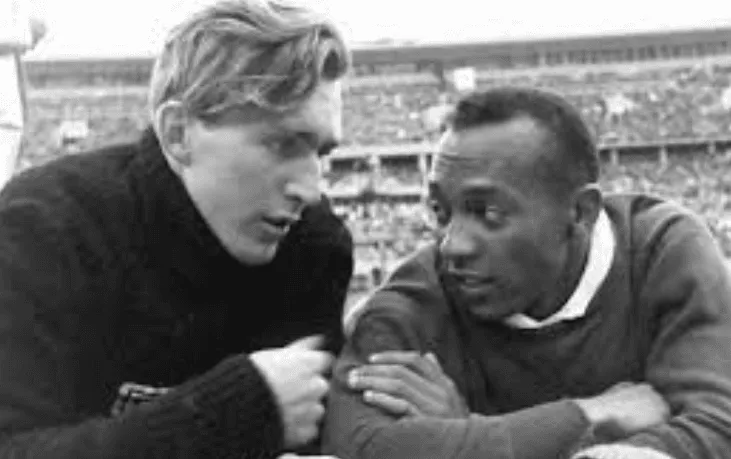
🧠 What caught my attention? It’s fascinating to see how powerful a story running can write. Owens wasn’t just an athlete; he was a symbol of defiance, pride and humanity. His duel with German long jumper Luz Long, who helped him in a sporting way even though he “was supposed to represent the Aryan ideal”, is one of the most beautiful moments of fair play in sporting history. Their friendship lasted beyond the Olympics but sadly didn’t survive the Second World War. Long was killed in Africa, and Jesse kept the promise he had made him in a letter: after the war he came to Germany, found his son and told him about his father.
The background to the “famous” film Olympia by Leni Riefenstahl, Hitler’s court director, is also interesting. During the Games she fought a fierce battle with Goebbels (she reportedly turned him down as a lover), who literally put obstacles in her way. Many scenes had to be filmed afterwards (partly because of the technical possibilities of the time).
https://www.youtube.com/watch?v=N0ouprKFnl4
But something deeper caught my attention too. The book indirectly asks: where does sport end and morality begin? In 1936 there was a lively debate in the USA about whether American athletes should take part in the Olympics in Nazi Germany at all. Some were strongly against: don’t go, because it would legitimise Hitler’s propaganda. Others said the opposite: let’s go and show that Black Americans can beat the Aryan “supermen”, that there is no superior race.
And history, as we know, likes to go round in circles.
Today, at a time of Russian aggression against Ukraine, the world sporting community faces a very similar question: should Russian athletes be part of the Olympics? We can look back at history again, and perhaps even ask ourselves uncomfortable questions. Back then, the world reproached the Germans for their attitude to Jews (although nobody could yet foresee the horrors of the Holocaust). But the Germans countered the Americans: “Look at how you treat your Black citizens. Don’t they have even fewer rights in your country than the Jews have here?”
📚 Style and readability Jeremy Schaap isn’t a dry historian; he’s a journalist. He writes briskly, vividly and readably. You dive into the atmosphere of the time without getting lost in too much data. The book balances between reportage and biography, and does it with great elegance.
🏁 Who is this book for?
For anyone who believes sport can be more than just performance
For every runner interested in the history of athletics
For fans of sport and the Olympic Games
For readers looking for inspiration in true stories